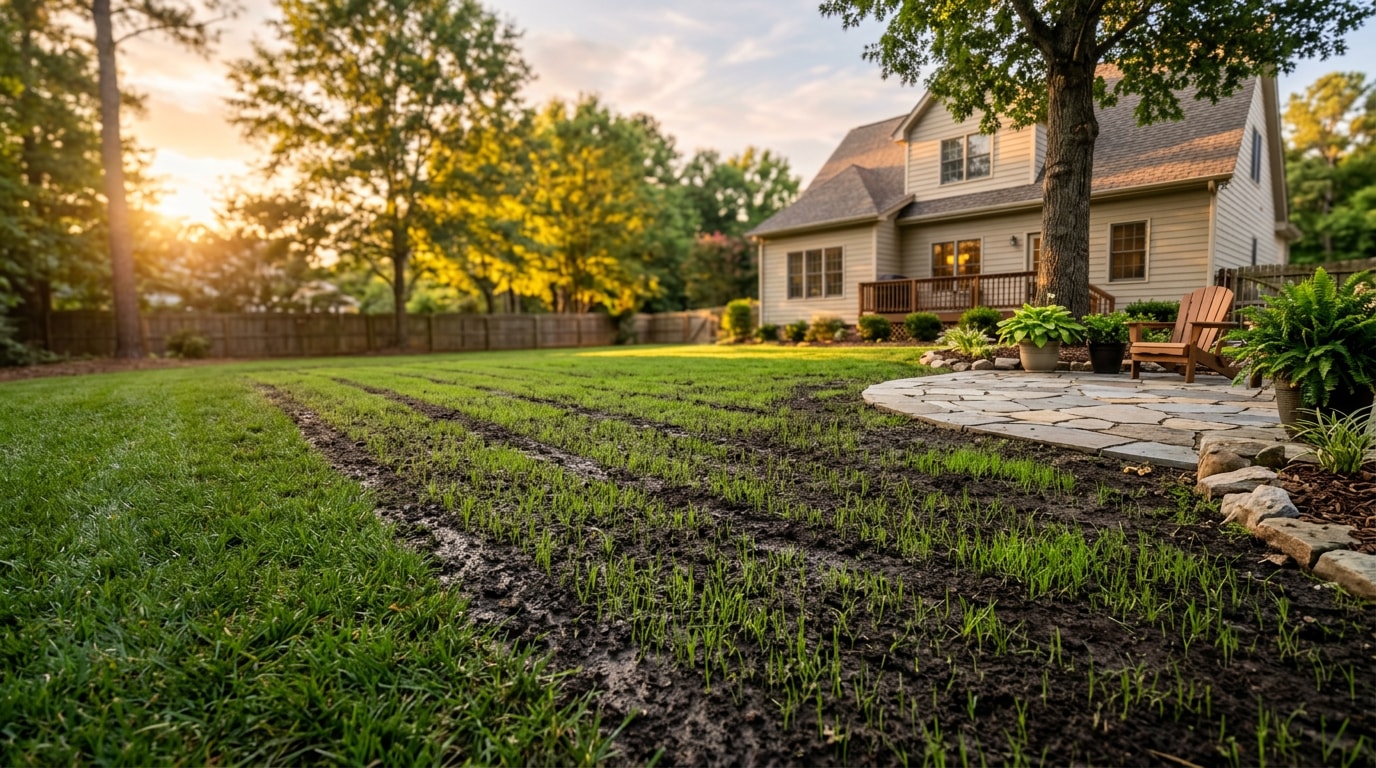
Knowing how to reseed a lawn in Wake Forest, NC starts with one date: September 1. That's the opening of the fall renovation window North Carolina State University Extension sets for tall fescue in our region, and missing it by even a few weeks can cost you a full season of thick, green turf. Here's the exact process our crews use whenever a patio, walkway, or retaining wall project disturbs turf on a Wake Forest property.
Visit Paradise Backyards LLC to see our services and request a free estimate.
When to Reseed a Lawn in Wake Forest, NC
Timing drives success more than any other single factor in a lawn renovation. For Piedmont and coastal plain North Carolina, which includes Wake Forest, overseeding of thin, bare areas should happen as weather cools, between September 1 and October 1 . Seedlings that go down in this window have an entire fall, winter, and spring to build roots before next summer's heat arrives.
Optimum temperatures for tall fescue germination occur when air temperature is between 68 to 77°F, and soil temperatures are above 60°F , which is exactly the pattern Wake Forest sees in mid-September most years.
| Factor | Early Fall (Sept 1–Oct 1) | Late Spring (Mar–Apr) |
|---|---|---|
| NC State renovation window | Primary window for Piedmont tall fescue | Not the recommended cool-season window |
| Germination conditions | Air 68–77°F, soil above 60°F and cooling | Soil warming fast toward summer stress |
| Weed competition | Low, summer annuals fading out | High, spring weeds sprout alongside new seed |
| Time to establish before stress | Full fall, winter, and spring | Roughly 8–10 weeks before July heat |
Spring seeding isn't off the table entirely. It's the better window for warm-season grasses like Bermuda, and warm-season lawns are best renovated in late spring to early summer . But for the tall fescue that covers most Wake Forest yards, late summer to early fall is the best time to renovate cool-season lawns, since seedlings survive the heat and drought stresses of summer better when they've established the previous fall and winter .
Choosing the Right Grass Seed and How Much to Buy
Tall fescue remains the top choice for most Wake Forest lawns because it tolerates both humid summers and occasional hard freezes better than other cool-season grasses. A quality blend of several tall fescue cultivars resists disease and drought more consistently than a single-variety bag.
Kentucky bluegrass fills in fast but struggles with Piedmont heat and drought stress. Perennial ryegrass germinates quickly and is often blended in for early cover while fescue takes hold. Bermuda grass spreads aggressively in full sun but goes brown and dormant every winter, so it's a poor match for a reseeding project aimed at year-round green.
Here's the number most guides skip: NC State Extension recommends a blend of turf-type tall fescue cultivars applied at 6 pounds of seed per 1,000 square feet for fall renovation. To figure out how much to buy, measure your lawn's square footage, divide by 1,000, then multiply by 6. A quarter-acre lawn (about 10,890 square feet) needs roughly 65 pounds of seed, split across two to three bags depending on brand.
Look for blue-tag certified seed on the label. Certification verifies germination rate and variety purity, which matters more for final density than almost any other purchase decision in this project.
Prepare Your Lawn Before You Seed
Prep work decides whether that seed actually survives its first two weeks in the ground.
- Test your soil. A simple soil test checks pH and nutrient levels before you buy fertilizer or lime. Tall fescue prefers a pH between 6.0 and 7.0, and correcting it ahead of time gives new roots a real shot.
- Mow and dethatch. Cut existing grass to about 2 to 2.5 inches and clear away clippings and thatch. This step improves seed-to-soil contact more than almost anything else you'll do.
- Aerate the soil. Compacted clay is the default condition on most Wake Forest lots, and it blocks seed from ever reaching bare soil. Core aeration pulls small plugs and opens the ground so seed can settle in instead of sitting on hardpan. If your yard also needs grading, drainage correction, or soil amendment before seeding, our site preparation crews handle that in the same visit.
- Apply starter fertilizer.
In the absence of a soil test recommendation, apply a starter-type, high-phosphorus fertilizer to push early root development.
- Hold off on pre-emergent herbicide. Pre-emergent products block grass seed from germinating right alongside weed seed, so skip them in the same window as overseeding. Post-emergent weed control is generally safe once new grass has been mowed a few times.
Step-by-Step Overseeding Process
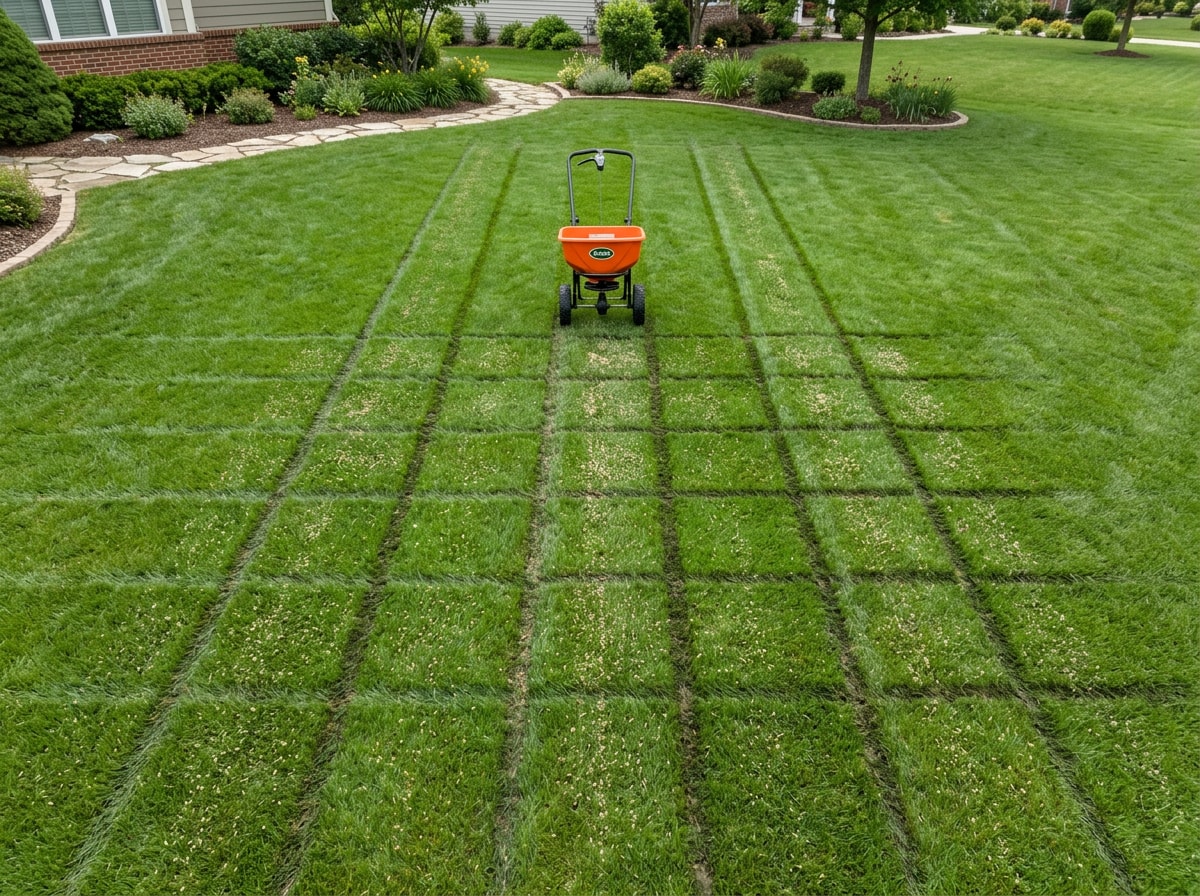
Once prep is done, the seeding step itself is simple. Set your broadcast spreader to the rate on the seed bag, then apply seed in a crosshatch pattern. Use a rotary or drop spreader to ensure uniform coverage, applying half of the seed in one direction and the other half at a right angle to the first pass . This overlapping pattern prevents the thin, striped look that happens when seed only goes down in one direction.
Follow seeding with a light pass of starter fertilizer, then water immediately and thoroughly to settle seed into contact with soil rather than washing it toward low spots or storm drains. From there, keep the seedbed moist with light watering several times per day, and do not let the seedlings dry out .
Watering and Mowing New Grass
New seed needs light, frequent watering, often two to three short sessions a day, until seedlings reach mowing height. Keep foot traffic off the area during this stretch since young roots pull out easily. On Wake Forest's clay-heavy lots, water slowly: water can easily pool on landscapes with clay-rich soils or slopes if it's applied too quickly , which wastes water and can wash seed away before it roots. The EPA WaterSense program has straightforward timing guidance if you're dialing in an irrigation schedule for the first time.
Hold off on that first mow until new grass reaches about 3 to 3.5 inches, then trim back toward a normal 2 to 2.5 inch height. Mowing too early can uproot tender seedlings before they've anchored.
Why Overseeding Matters for Wake Forest Lawns
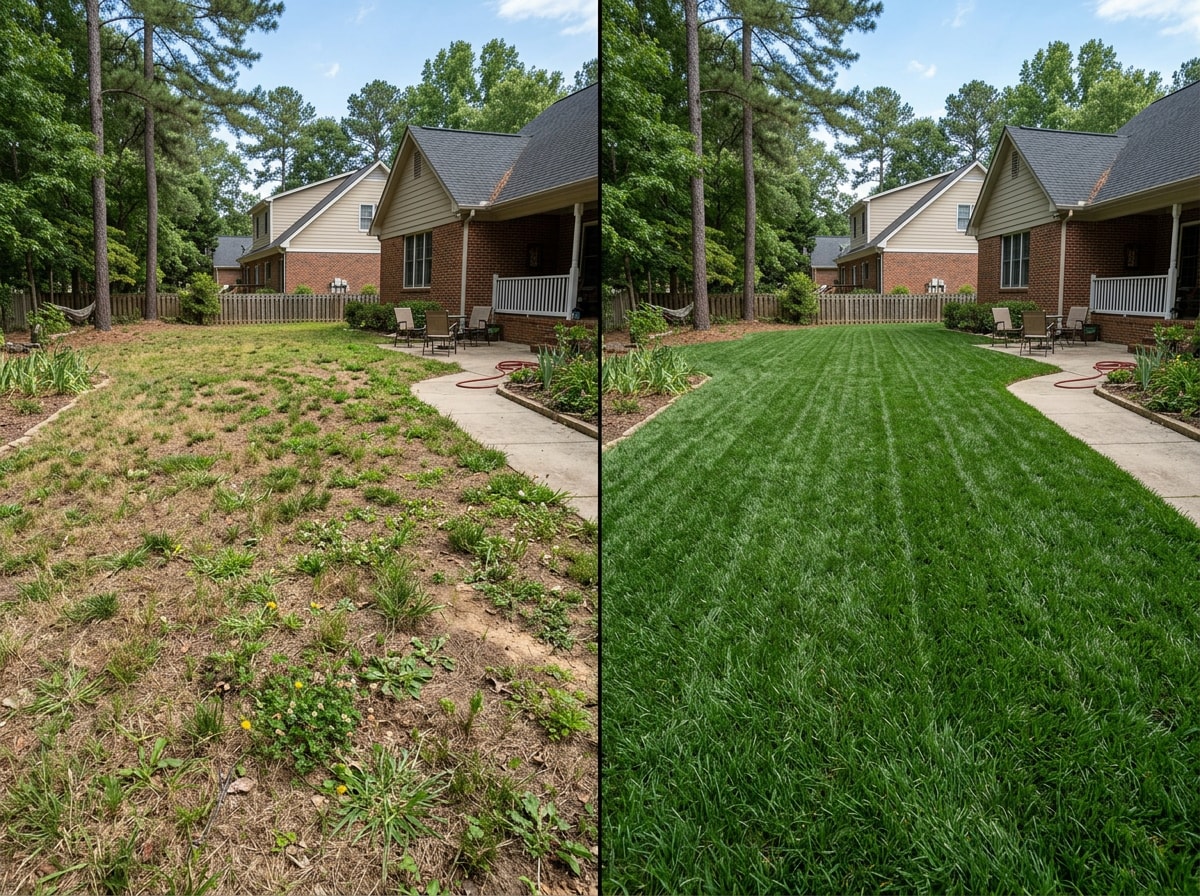
Thin lawns and bare patches are practically a rite of passage after a Piedmont summer. Heat, drought, and foot traffic wear down fescue stands, and weeds move into every gap left behind. Overseeding thickens the canopy, strengthens the root system, and shades out new weed growth before it gets a foothold.
Wake Forest sits in USDA Hardiness Zone 8a, with average annual lows between 10°F and 15°F , according to the current USDA Plant Hardiness Zone Map. That zone classification, combined with our clay soils, is exactly why fall seeding windows and proper aeration matter more here than in sandier, milder climates. On sloped lots especially, denser turf also means less erosion during heavy rain, since a thick lawn holds soil in place far better than a patchy one.
That density is the whole point of reseeding instead of just patching a few spots and hoping for the best. It's also the reason our crews regrade and reseed disturbed lawn edges after nearly every patio installation or retaining wall project we finish in Wake Forest, so the new hardscape sits in a lawn that actually fills back in.
If your whole yard needs a plan, not just a patch job, our landscape design team can map out turf areas, beds, and hardscape together from the start. Ready to get started? Get a free estimate and we'll walk your property with you.
FAQ
What is the best grass seed for Wake Forest lawns?
Tall fescue is the best choice for most Wake Forest lawns because it handles the transition-zone climate's humid summers and occasional hard freezes better than other cool-season grasses. A certified tall fescue blend gives the most reliable results for density and disease resistance.
When should I overseed my lawn in Wake Forest, NC?
Between September 1 and October 1 is the NC State-recommended window for this region. That timing gives tall fescue cool soil, fading weed pressure, and a full fall-to-spring runway before next summer's heat.
How much grass seed do I need per 1,000 square feet?
Plan on 6 pounds of turf-type tall fescue seed per 1,000 square feet for a standard fall renovation, which is the rate NC State Extension publishes for this region. Measure your lawn, divide by 1,000, then multiply by 6 to get your total.
How often should I overseed my lawn?
Most Wake Forest lawns benefit from overseeding every one to two years to maintain thick, even density. Yards with heavy shade, foot traffic, or drainage problems may need it more often.
Can I overseed without aeration?
You can, but skipping aeration cuts seed-to-soil contact and lowers germination success, especially on compacted Piedmont clay. Pairing core aeration with seeding is the more reliable approach for a lawn that actually fills in.
Should I use pre-emergent herbicide when I overseed?
No. Pre-emergent herbicides block germination broadly, so they'll stop your new grass seed right along with weed seed. Wait until new grass has been mowed a few times before starting any post-emergent weed control.